

Where do the Persian cats come from?
Let’s begin with the history of Persian Cat
The Persian cats can be traced back to circa 1600, from Iran (originally called Persia), which explains their name. The exact history of this specific breed seems to be quite a mystery as many of these long-haired cats were seen in Egyptian hieroglyphics, around 1600 B.C. Persians were considered exotic in the19th and 20th centuries as it was not common to see long-haired cats versus short-haired ones. That’s the reason why commoners were not able to acquire this aristocratic expensive breed and the fact they originated from Persia (Iran). Owning a Persian cat during those times was a status symbol for the upper class of society.
They were first presented at the world’s first organized cat show in 1871 in London, then finally made their way to the United States of America in the early 1900’s.
Presently, Persian cats are, in North America, one of the highest regarded breeds.
What are the characteristics of Persian cats?
It is well acknowledged that Persian cats are the epitome of elegance. Their laid-back personality makes them a pleasure to be around. The Persian breed is known as Brachycephalic breed, which literally means “short head” and a flat face compared to other domestic cats. Their morphology is really unique which means they have dedicated needs in care, food and are more delicate than other feline breeds.
Persians are prized for their long silky fur, short legs and wide expressive round eyes. Their soft fur comes in an astonishing number of colors. To just name a few, you can find them in silver, white, black, blue, tortoiseshell, lilac, red, tabby, cream colors along with other variations depending on their ancestors.
Persian cat eyes
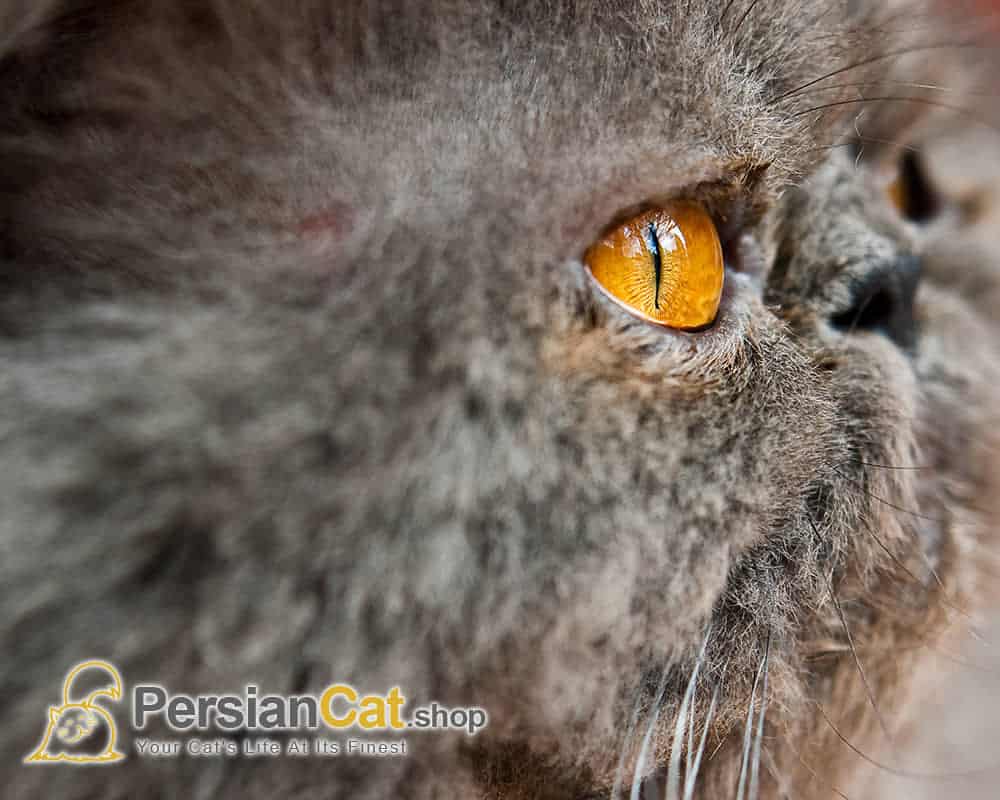
Predominantly they have copper eyes but you can find some with blue-eyes, some with green-eyes and two odd-eyed colors (condition called heterochromia). Those Persian cats are highly prized.
Any adult male Persian weighs approximately between 9 -13 lbs (4 kg-6 kg) and females 7-10 lbs (3.2 kg- 4.5 kg). They can easily live 15 years and some over 20 years.
The Cat Fanciers’ Association (CFA), actually defines in a very specific manner the characteristics of The best Persian cat, regarding size of head, placement of ears, color of fur, to determine precisely the highest pureness of this cat breed.
Persian cat shape
Generally speaking, the ideal Persian presents a heavily boned, well-balanced cat with soft, round lines. The large round eyes are set wide apart in a large round head to compliment the overall look and expression. The long thick but soft fur softens the lines of the cat to compliment the sphericity, roundness of the body.
The perfect body type shall be with a round face set on a short and thick neck, with brilliant round eyes well centered but far apart from each other. From a profile view, the eyes are prominent and chin, nose and forehead are in total vertical alignment. The shape of the skull must be smooth and round to the touch. The ears set far apart must be small with round tips and low on the head. The body is set on low and straight legs, equally broad and deep throughout with a good muscle tone without any signs of being overweight. The paws are large and round, carrying five claws in front and four in their back paws.
The tail shall be proportionate to the body length, not too long nor too short. The fur is standing off from the body, made of a fine, soft and glossy texture.
Persian cat grooming
To keep your Persian cat looking his best, requires a great deal of effort. If you do not regularly groom their long and flowing coat, it could quickly become a nightmare for you and a serious problem for the health of their skin. Perfect grooming can only be achieved if your cat is in first-class condition, using a metal comb to untangle knots, which are usually found underneath their legs, belly and collar bone. To remove excess oil, dead skin and stimulate the growth of a new coat, it is necessary to bathe your cat once or twice a month.
Being indoor cats, it is absolutely essential for their health and muscle tone to establish a daily routine of exercise. Provide them interactive teasing toys for them to play with if you are away at work. Whenever you’re home, encourage them to play with you. Your cat will show you how rewarding it is to watch them having fun.
Why do people love Persian cats?
Persian cats display a sweet and gentle personality that adapts well to a quiet family life. The way they communicate is through their large expressive eyes and their melodic voice. Playful but never demanding, Persian cats won’t climb curtains, jump atop a bookshelf nor destroy furniture. It is just not in their sedate nature. Nonetheless they enjoy playing with their owners in a more steady and doglike manner, showing devotion to the special people in their lives. They are very affectionate, love to be around their owners to be petted and cuddled. They tend to purr a lot. That’s their way to show you their appreciation when you care about their needs, such as grooming, cuddling or even while they are eating. This makes them the most loving and loyal furry companions, even if sometimes they tend to be reserved.
They always provide unconditional love when their owner makes a commitment to their daily life. That commitment can go from playing with interactive toys, caring for their fur, feeding them with healthy food and respecting their nap time and privacy. Like in any relationship, it takes time to build up trust. It is so rewarding and worthy to develop that kind of loving bond with your Persian cat.
